Have your say on the environmental impact statement
Visit the New England REZ engagement portal to view the interactive map, fact sheets, digital resources and more.


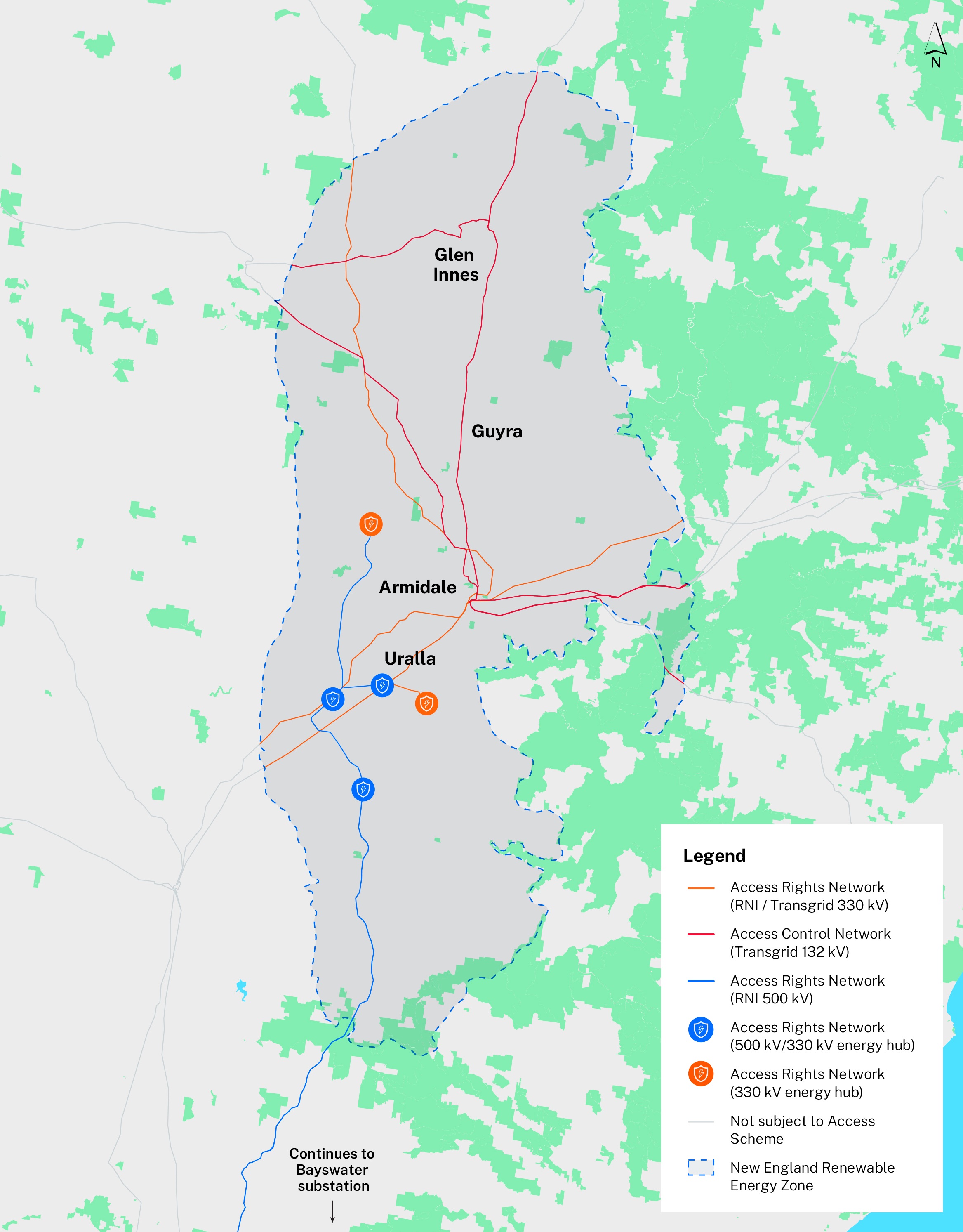
How will access to the network be controlled?
The Access Scheme uses two complementary tools to control access to network infrastructure covered by the Access Scheme.

Access Rights Regime
This applies to Projects seeking to connect to the Access Rights Network, which includes:
- New REZ Network Infrastructure operating at 330kV and 500kV within the REZ boundary.
- Existing and future 330kV network infrastructure within the REZ boundary.
- New 500kV REZ Network Infrastructure connecting from the REZ boundary to Bayswater Substation.

Access Control Mechanism
The Access Control Mechanism applies to projects seeking to connect to the Access Control Network, which includes:
- Existing and future 132 kV network infrastructure within the REZ boundary.
What happens next
As the Consumer Trustee under the Electricity Infrastructure Investment Act 2020, AusEnergy Services Limited (ASL) will soon commence consultation on its approach to setting access fees for the New England REZ.
Further information will be available on the ASL website once consultation begins.
EnergyCo will soon publish the New England REZ Access Consent and Early Access Application Process Guidelines.
The consultation will invite feedback on the proposed application process and assessment criteria, which have been refined following previous stakeholder consultation.
This feedback will help inform the final guidelines and support implementation of the Access Scheme.
Further updates will be published on EnergyCo website.
The Draft New England REZ Access Scheme Declaration was exhibited from 6 July to 6 August 2026, together with a positions paper and Draft REZ Consent Assessment Process.
The positions paper outlined the rationale behind key policy positions and detailed how stakeholder feedback on the New England REZ Generation and Storage Consultation Paper (released in August 2025) had been incorporated.
EnergyCo received feedback from a broad range of stakeholders during the exhibition period. This feedback informed a number of refinements to improve the clarity and operation of the final Access Scheme Declaration.
Details of these refinements are available in the supplementary positions paper.
Supporting documents:
- Draft New England Renewable Energy Zone Access Scheme Declaration (PDF, 600 KB)
- New England Access Scheme Positions paper (PDF, 8.3 MB)
- Draft REZ Consent Assessment Process (PDF, 1.8 MB)
- New England Renewable Energy Zone System Strength Model Position Paper (August 2026) (PDF, 567 KB)
- Have your say on the draft Access Scheme (PDF, 1.8 MB)
- Capacity Methodology for Access Rights Regime (PDF, 5.1 MB)
- Webinar recordings on 14 July 2026:
In December 2025 we published a discussion paper outlining our indicative technical requirements for generation and storage projects seeking to connect to the New England Renewable Energy Zone (REZ).
Why released this paper
The New England REZ will bring together new solar, wind and storage projects, supported by new transmission infrastructure. To ensure the REZ operates safely, reliably and efficiently, We're developing a set of REZ access standards – technical requirements that generator and storage projects may need to meet when connecting to REZ network infrastructure.
This paper provided early guidance now so industry proponents can plan ahead. It outlines our indicative position on a range of technical requirements, including areas where they may differ from the standards normally applied under the National Electricity Rules.
What the paper covers
The discussion paper provides:
- EnergyCo’s early views on a subset of technical requirements for solar, wind and battery projects
- information on where we are proposing to apply minimum or automatic access standards
- areas where requirements may differ based on the unique characteristics of the New England REZ
- details on which requirements still need further power system studies before they can be defined
- next steps on how access standards for New England REZ will be developed.
The indicative requirements in the paper were not final and are evolving as REZ planning progresses.
In August 2025, EnergyCo published the New England Renewable Energy Zone Generation and Storage Consultation Paper, outlining proposed design features under consideration for a potential access scheme, a connection assets model and the provision of system strength for the New England REZ.
We considered these submissions to inform the next stages of detailed design, shaping how we approach generation and storage for the New England REZ.
Download the consultation paper
Webinar
We hosted a public webinar on 26 August 2025 to provide stakeholders with an overview of the paper and key design questions, and provide an opportunity to participate in a Q&A.
Documents
Consultation paper and related documents
- Generation and storage strategy consultation paper
- Generation and storage strategy consulation paper - submission form
- Generation and storage strategy consultation paper – information sheet
Fact sheets
TTCL and AMCC – questions and answers
Technical curtailment is a measure of how much electricity cannot be sent out by renewable energy projects when there is not enough room on the transmission lines.
This is most likely to take place on days when renewable energy generation is very high, such as sunny and windy days, when electricity production exceeds available transmission capacity.
Energy storage, such as batteries, can help by storing excess electricity when generation is high and releasing it later when it is needed. However, there may still be times when generation exceeds both storage and network capacity.
Allowing some technical curtailment can avoid the need to build additional transmission infrastructure that may only be required for short periods of time. This helps ensure the network is used efficiently and helps manage impacts on local communities.
The Target Transmission Curtailment Level (TTCL) and Aggregate Maximum Capacity Cap (AMCC) are planning tools EnergyCo uses to determine how much renewable energy generation and storage can connect within a REZ.
The TTCL is the average technical curtailment that projects in a Renewable Energy Zone can expect to experience in a year. It helps EnergyCo find a balance between getting the most use out of the transmission lines across the REZ while limiting how much electricity is not sent out from projects in the REZ.
The AMCC sets the maximum amount of renewable energy generation that can be built within the REZ.
In simple terms, the TTCL helps determine the AMCC, and the AMCC sets the overall amount of renewable energy generation that can connect to the REZ.
These measures help limit the overall scale of renewable energy development within a Renewable Energy Zone.
By setting a cap on the amount of renewable energy generation that can connect, EnergyCo can make better use of existing transmission infrastructure and reduce the need for additional network infrastructure in the future.
For local communities, this means renewable energy development can be planned in a more coordinated way, limiting the volume of projects while continuing to deliver reliable electricity to NSW homes and businesses.
For projects that receive Access Rights, they can expect to experience less technical curtailment and send out more of the electricity they generate. It is important to note that the TTCL is not a guaranteed level of technical curtailment for projects and it doesn’t consider any curtailment that occurs due to transmission capacity limits outside of the REZ or economic dispatch.
Industry information
Contact the New England REZ team
Phone 1800 061 114 (toll free), Monday to Friday, 9am to 5 pm
Send us an email at: nerez@energyco.nsw.gov.au
Learn more, see upcoming events and provide feedback
Sign up for the New England REZ e-newsletter
Get in touch with EnergyCo
Call 1800 118 894 (9 am to 5 pm, Monday to Friday)
Sign up for our Powering NSW e-newsletter